Showing posts with label animal shelters. Show all posts

Monday, July 27, 2015

The mechanics of pulling a dog

When rescue groups take dogs from public shelters, it’s called “pulling.”  There are many factors that determine when we pull a dog and which dog to pull.  It’s an art rather than a science, but there are some rational considerations that shape these decisions.  We are working on developing a fuller set of guidelines, to make the process as clear and transparent as possible.

To that end, we’d like to let our volunteers and friends know what the current guiding factors are and also ask for your suggestions, questions, and wishes to help us develop a fuller and clearer plan.


Before we get to specific guidelines for pulling that we might develop, here are some things to remember about our organization:

- We are an all-volunteer group.  No one does this full time.

- Each dog we add generates work and costs far beyond the obvious.  Each dog needs vet visits, food and supplies, rides to events, training and socialization, Petfinder listings, Facebook posts, and much more, and all of those needs make work for lots of different people.  Every dog requires a lot of volunteer time not just from the foster but from the folks doing fundraising, replying to emails, updating Petfinder, staffing events, and so forth.

- One of our goals is to save as many lives as possible, but we have additional goals that take up volunteer time as well, including education and advocacy work, training, shelter support, and other projects that, in the long run, contribute to better lives for dogs – but that, in the short run, place some limits on the number of dogs we pull. 

- Who decides?  Decisions about adding dogs are made by our five-member board of directors (required as part of our 501c3 status), but we are a fairly decentralized group and other volunteers have lots of input into every aspect of what we do.  We try especially to make sure we check with the people who will be most affected when a dog is added.  Thus we might say "no" if the foster coordinator or event coordinators are feeling overwhelmed, even if there is a spot available.  Or we might say "yes" when a long-time foster wants to us to pull a dog and offers to foster the dog as an "extra."  It's an art, not a science.


With that in mind, what are the factors that enter into the decision to pull a dog?

- Total number of dogs in the program currently.  We’ve found that once we approach 30 dogs, the logistics of events, supplies, etc. get difficult.  20-25 seems to be a good number.

- Mix of dogs in the program currently.  We usually have some dogs in treatment for heartworm or another condition who aren’t quite ready for adoption.  Among adoptables, we like to have a mix of puppies and adults and males and females, as well as a range of ages, sizes, and personalities.   This is important for adopters, who often have a particular kind of dog in mind.  If we’re especially heavy on boys at a given time, we may prefer to pull a female, or if we currently have a lot of dogs in treatment, we may want to pull one who’s ready to be adopted. 

- Shelter of origin.  As a breed rescue, we pull from a number of local shelters, including Alachua, Bradford, Clay, Gilchrist, Levy, Orange, and Putnam counties.  We try to support them all, and we try to have dogs from a range of those shelters in our program.  There are different reasons to pull from one or the other.  Alachua is by far the easiest to work with – it’s local, they vaccinate and heartworm test on intake, and they do good temperament tests and answer all our questions.  However, they have a much lower kill rate than any other shelter we work with, partly because there are more rescues working in Gainesville than other places.

- Available foster homes.  Very few fosters can take just any old dog.  Most have restrictions, based on their own pets and human household, their schedules, the size of their home, their location, whether or not they have a yard, etc.  Thus we may have a foster available who can only take a dog- and cat-friendly adult male dog, for example. 

- Foster juggling.  Often we have to move dogs around, because a foster is moving, or their home situation changes, or the placement isn’t working out, or the dog has finished treatment, etc. Juggling foster homes is really hard, because few fosters want to give up one who’s settled into their home, and we hate to move dogs around more than necessary.  Sometimes we have a dog who needs a new foster home, and an available foster home that can’t take that particular kind of dog (e.g., maybe the one in need isn’t good with cats). In those circumstances, we may pull a new dog even if there’s one who needs a new foster.  We prioritize the needs of our current dogs, but we don’t want to refuse to add an appropriate new dog when there’s a spot available that wouldn’t work for another one.

- Finances.  Dogs from rural shelters are more expensive than ones from Alachua County, because they need more testing and vetting.  Dogs with health conditions are more expensive than healthy ones – not just because of the vet care, but also because they end up staying longer.  And there are always surprises, such as medical emergencies.  Our budget is extremely limited and we can’t take in too many expensive dogs at a time.

- Special circumstances.  We love all dogs, but we love underdogs in particular.  We try to give a chance to dogs who otherwise wouldn’t have one.  That means we prioritize victims of cruelty and neglect, dogs with heartworm and other treatable health conditions, and dogs at high-kill shelters.

 So how do we decide when to add a dog?

We can add a dog when our numbers are not too high, when our finances look solid, and when we have an open foster spot.  Sometimes this happens because we get a new foster.  Sometimes it happens because a dog is adopted and the foster says “I”m ready for another!” 

When that happens, we look for a dog at risk of euthanasia who is a good fit for that foster.  Several different volunteers get lists of dogs at risk at many shelters on a daily basis, and we try to keep likely dogs in mind.  We have several volunteers who visit shelters to temperament test for us, and they go knowing exactly what kind of dog is going to work in the space available.  They give us as much information as possible, we consult with the foster, and if it all looks good, we pull the dog.


In addition, there are a couple of other scenarios that sometimes lead to us pulling a dog, when someone brings a particular dog to our attention.  The board still approves the decision to add the dog.

Sometimes we get a request from a shelter volunteer or staff person who has fallen in love with a special dog.  When that happens, we try to meet the dog to see if she or he is a good fit for POPB.  If so, we try to recruit a new foster home. 

Sometimes a foster asks us to pull a particular dog to be placed in her/his home.  We will do that if the dog has a great temperament, our numbers aren’t too high, our budget isn’t too stretched, AND the foster promises to commit to the dog until adoption.

We hope this helps clear up some questions you might have had, and that you’ll tell us what you think we should prioritize, factors we haven’t mentioned here, and anything else that will help us help more dogs!


Wednesday, July 8, 2015

Stella


Here's the first in a series of posts about fostering and adopting some special dogs, beginning with the story of Stella, as told by her mom JoAnna.

I got very very lucky. I knew I wanted to foster as SOON as I was in an apartment of my own (my entire family did their best to dissuade me, stating that there was no way I could foster without trying to adopt my dogs. I was determined to prove them wrong - after all, I was in no position to adopt a dog at this point in my life! But I still needed to help somehow so I would foster and foster only).

I had always liked pit bulls (even though I never had much personal experience with them...although I made a mask in elementary school that was supposed to represent my interests and it had a feather, a Friesian horse, and an APBT on it) and since POPB seemed to be the only large-dog only rescue in the area I wanted to go with that, since I wanted to avoid small dogs at all costs. But I had seen a lot of nice seeming posts by Phoenix and someone I knew fostered for them, so I decided to go with them since I really wanted to get involved with a nice community comprised of sane people and that is what they appeared to be on the outside. As I was about to fill out the app for them, I got a very nice email from Rachel, encouraging me to submit a foster application. It was this email that saved me from falling into a horrible horrible situation, and I think almost weekly about how lucky I was that I was sucked into the wonderfulness that is POPB instead of another, less desirable rescue.


First, I was assigned to Annie. As luck would have it, dogs needed to be moved around and Pat didn't want Annie going anywhere until it was to her forever home so I got reassigned to Stella. I cracked up because I'd stalked Petfinder hard and I was aware that I went from the least pit bull-y looking dog possible to the most pit bull-y looking of our lineup. I found a cat that week that I was supposed to get her and I tried to delay getting Stella because she was not cat friendly. Luckily, Katie offered to house the cat for me until her people could be located (no such luck) or a home found. After much difficulty arranging a time to get Stella from Lacey (this was during my pre-car days), Lynne dropped her off with me. I brought the little wild thing up to my room and tried to decide if I should allow her on the bed. Stella solved that problem for me by making it the very first thing she did. (Since then, I can't sleep comfortably in that bed without Stella as my pillow/foot rest/space heater.) Stella sat up on my bed, offered me her paw, and smiled reaaaaally big. That was when I knew it was going to go well.

5 months later, her holiday foster wanted to adopt her. I was an anxious wreck for WEEKS trying to decide if this would be a good situation for her and trying to decipher how much of my hesitation was due to me being an overprotective first time foster mom and how much was legitimate concern. The wonderful team at POPB took my concerns into consideration and we eventually came to the conclusion that Stella would not be staying with her. As time passed, more and more evidence came to light that we absolutely made the correct decision. Not many rescues would take so much care to see if a home was worth it, especially for a difficult to place dog, and not many would listen to the foster home as carefully as POPB does. One night (while Stella was still with her temp foster/at that point possible adopter) I found out a little black pit that I had saved from traffic had been euthanized at ACAS (I tried to house the dog here but Stella was not having it and at that point I did not know how to manage her nearly as well as I do now). I sobbed and sobbed and did not have Stella with me to comfort me. That felt so wrong. Months later I would think back on a horse, Honey, that I had loved (and lost) in a similar situation to my current one with Stella (she was in no way mine and I couldn't make her mine and her future was uncertain because decisions about her were not mine to make) and Stella came over and gingerly climbed up on my lap and licked my tears and between my sobs I told her that I couldn't let her go. But I was lost because I knew that my future held extended trips out of the country to countries that would not allow pit bulls. I didn't know what to do. Lots of stress and fruitless begging of family members and periodic bouts of panic ensued. Sometime in this time period I would start to slip up and call her "my dog" instead of "my foster dog" and friends were shocked that she wasn't actually mine and my family members called her "JoAnna's dog."


Fast forward 11 months from the day that I started fostering her, and I got a phone call from my mom that I needed to go home, get Stella, and call her. She wouldn't tell me the news until I was with Stella. When I found out my dad had died, Stella was the only one there to comfort me. In the next few hours, she was as attentive and gentle with me as any human could have ever been. When I met up with the rest of my family, Stella not only comforted me but also did her best to show everyone some much needed unconditional love.


 At one point my brother pointed out that Stella was shaking because I was, and everyone noticed that she would sit outside of the bathroom door, staring at it, as I showered, and that she invariably slept with as much of her body touching me as possible. The night before the funeral, my mom told me that she could not watch me go through what I went through with Honey again and that Stella was a "forever friend" to our family from that point on; I immiately wrote the board. My mom called up her landlord and told him that she was moving out because he didn't allow pets and she would have a granddog living with her soon (he told her he was going to make an exception for her until she told him the breed....knew I always hated him for a reason), since her daughter was going to Australia. She told all her siblings that they could expect to live with a pit bull when she/they go to take care of my Grandma, even though they have terrible close-minded opinions of pit bulls typical of the Detroit area. You'd think after 11 months of Stella not killing me in my sleep (as they predicted) they would be less judgmental, but nope. They need some immersion therapy with the real thing for that! She has already converted my uncle...the rest will follow suit.


I LOVE how my entire immediate family likes Stella and considers this a gain not just for me but for all of them as well. Chris constantly would cuddle her and must have told her what a good dog she was 20x in 5 days. As soon as Karl read about the murdered ACAS puppy he came right over to Stella and scooped her up and professed his love for her and the breed over and over and over, and then told Stella a bed time story about the time he carried a 45 lb pit bull named Tiny 5 miles out of the Hawaiian jungles on his shoulders after she was injured by a boar. Mary let Stella in her car and come over to her apartment without a crate and even let her onto her couch (a big deal for her). Steffi is overjoyed at having a new sister and can't wait to play more music to her and be silly with her. And my mom babies Stella more than anyone, even though the prey drive/reactivity is something completely foreign and intimidating to her. She is taking every opportunity to learn about management and actually listens to my explanation of behaviors (most people do not) and before anything else makes sure Stella is comfortable and happy and knows how much of a good baby she is. I love more than anything when those I love appreciate each other, and this is one of those cases. While Stella is in many ways the opposite of the black lab we had for 15 years growing up, she is becoming just as accepted by my family and that makes me almost as happy as Stella herself does. Stella is not without her challenges, which also means that I get to grow in my understanding of behavior and training and dogs in general as we work together on these things. I am very excited for a future with her.

Plus, I justify to myself, what kind of photographer can grow without a beautiful muse with soulful eyes for inspiration (who may or may not work for hot dogs).

                                                                                           - JoAnna Platzer

Sunday, July 5, 2015

The Story of Wilson


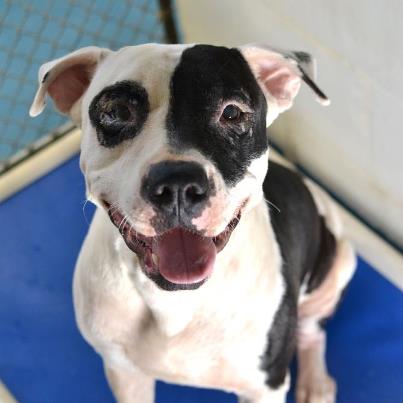
Who's Wilson?  Our icon, muse, and favorite eye-patchy smiler.  You see his face everywhere, but you might not know how he came to be the charismatic face of Plenty of Pit Bulls.


We asked Wilson's mom, Julie, to share the story.

One day back in January 2012, as we driving through our neighborhood, we saw a white dog skulking along the side of the road. He had a funny 'swingy' gait (sort of s-shaped, like a snake). We didn't stop as we just assumed he was 'attached' to his owner who was down the road somewhere. Then the next day we saw him again as we were out walking our two dogs - he was way ahead of us, turning a corner. We stopped to chat to a neighbor who said they had also seen the dog as it had camped out in their back yard the night before (they are not dog people, so they didn't go out to see him). So now we knew he was a stray.


Wilson, the night Julie and Craig found him
Another day went by without another sighting and we think he must have been found by his owner. But then on the third day, my husband saw him again while he was out running and when he got home, we decided we had to go get this dog off the street. So we set out, my husband driving, me in the passenger seat with the treat bag. It took an hour before we finally got the dog to stop when we got out of the car, rather than run away. It took another 15 minutes before we managed to get close enough to slip a lead around his neck (he would not go in the car). No collar, no tag, our only hope a microchip.

We finally get him into our back yard by throwing treats ahead of him and keeping hold of that lead. By this time it's 7.30pm on Saturday night. The vet is closed until Monday, ACAS is closed until Tuesday - he is clearly staying the night.


We decided to leave him outside in the yard so we didn't have to deal with him 'meeting' our two dogs. That didn't work. I was so worried he'd get out, I kept popping up every half and hour to see if he was still there - he was, in the same place every time, curled up in the dirt by the back gate. We decided that in the interests of sleep we should get him in the kitchen. Another 30 mins later we finally persuade him inside (my how the tables have turned, these days he will always choose the comfort of the AC over hanging out in the yard).

I can't totally remember the sequence of events from here but we took him to the vet and established he had no microchip, then posted pictures of him all over the place.

Nothing.

So we call ACAS on Tuesday and they come and get him. We watch them put him in the van, a bit teary eyed, and make sure to get his ID number so we can keep track of him over the next few days.

Nothing.

It's now Valentine's Day. As 'luck' would have it, his is 3-day hold is up, he's passed his temperament test but failed his health test (heartworm), which means he's going to be euthanized. Urgh.

Wilson in his Valentine's Day ribbon

My husband is away so I call him to discuss the situation. We agree we cannot let him die.
I send a message to the rescue from whom we had adopted our last dog.  No reply, but someone called Anna jumps in and tells me that they have no spare fosters but if we would be willing to foster ourselves, she can arrange for him to be 'pulled' (lots of strange lingo in those early days).

Well. I absolutely did not want a third dog - even temporarily - but I couldn't see any alternative.
So on Wednesday February 14th 2012 I go to ACAS to rescue a dog. He is wild looking, filthy dirty and hyper. I felt like I'd bitten off more than I could chew (not a concern he shared, naturally).

That night, with this strange animal in a crate in the kitchen and my other two dogs sniffing furiously under the kitchen door, I sit down to watch Bridesmaids. I'm at the bit where the maid of honor is on her sofa watching 'Castaway'. Tom Hanks is drifting out to sea on a raft - and he wakes to realize that his only friend, Wilson the football, has come loose from the raft and is bobbing further and further away. 'Wilssssooooooon'.

And so he was named - Wilson - the castaway.


First week was a nightmare....

- Rotating dogs between house and yard, so we could introduce them the slow way (thank god that worked - he LOVES the two girls, though they wouldn't notice if he left tomorrow LOL).

- Trying to walk a wild animal who had clearly never had a lead put on, let alone been taken on a walk (he leapt and bound like a deer, dragging me behind him for a block before I decided enough was enough).

Right away we started doing adoption days (we were more than keen to revert to a two dog household) - only that was even more of a nightmare. He lunged and snarled at the other dogs from the moment he got out of the car at 11am until the moment he was put back in at 5pm. I spent hours standing by his crate, ready with the water spray, but after several such Saturdays we decided this wasn't the best place for him to be - too stressful for all concerned.

And so he became a social media dog.


He got lots of fans and lots of likes on his posts - but for some reason an entire year went by and nobody filled out an adoption form (I have come to believe he was writing spells during this time to conjure up a foster failure).

Then Anna got a spot at Petco for adoption events and we decided to try him again because he'd been doing so well at the Sunday training classes (courtesy of his amazing advocate, Kristy Schmidt). It took one weekend of being in Petco -- with Wilson being an angel in his crate and giving me the big eyes, as if to say "Mum - are we really having to do all this all over again?" -- for us to decide we'd rather spend our Saturdays hanging out with him on the patio than hanging out with him in Petco.


And so it came to pass that Wilson was officially adopted on April 1st 2014 - and is now living happily ever after in an air conditioned house in the Duckpond with his two sisters - what one might call a successful foster failure conjuring.

Happy Days from here on in

And fame to boot.

                                                                                                 - Julie Knox


Friday, May 17, 2013

Northward Bound

A couple of the dog books I’ve read lately have addressed the transport of shelter dogs (mostly puppies) from mostly rural shelters in the south to private shelters in the northeast.  Both the authors are journalists living in the New York area who adopted puppies relocated from the south.  One, Kim Kavin’s Little Boy Blue, is focused entirely on the story of how her dog Blue got from North Carolina to New Jersey.


The other, John Homans’s What’s a Dog For?, discusses the background of his dog Stella (from Tennessee) as one piece of a larger discussion on contemporary humans’ relationships with dogs.  In their discussions of the transport movement, both authors raise some important and difficult issues about dog rescue, breed identity, and more.

 Homans calls the transport movement “The Great Migration.” a catchy but inaccurate term.  The movement of dogs from south to north (or as Homans puts it, from red states to blue states) is not really migration as much as a redistribution of resources.  Some authors use the term “underground railroad,” again catchy but inaccurate, since the transport network is not illegal, as was the movement of slaves from south to north.  Nor is moving dogs around an act of civil disobedience, although it can certainly be seen, at least from some perspectives, as an act of protest against shelter conditions, the methods used to kill dogs in some counties, and the scale on which the killing occurs.


Both books (published in fall 2012) sold well and were generally well reviewed, and Little Boy Blue has won several awards.  I found both smart, interesting, and ultimately unsatisfactory.  Part of my dissatisfaction came from the fact that neither author dug deeply enough, or thought hard enough, about the larger questions raised by their own dogs’ histories and the larger transport movement.  The biggest issue, perhaps, is raised by a Pennsylvania activist quoted by Kavin.  After pointing out that over 70,000 dogs entered Pennsylvania shelters in 2009 alone, she asks “Why the hell are these rescue groups bringing more into the state?”  In other words, is it ethical to transport puppies hundreds of miles to places where thousands of other adoptable dogs are already waiting for homes?

Behind this big question lurk a host of more specific issues, including the fact that transport spreads disease and the fact that the whole movement is largely unregulated, decentralized, and thus ripe for abuse.  All of these issues deserve attention (and to her credit, Kavin does address the last issue in some detail).  I want to focus here on two questions: one about geography and another about breed.


Regarding geography, both Homans and Kavin take for granted that there is a clear-cut and dramatic clash between northern and southern culture regarding the treatment of dogs, as most other issues.  As Homans puts it, “Most fundamentally the dog market is an ongoing transaction between the red states and the blue states, and it’s based on the same basic differences in core values that make our presidential elections so dramatic.  The flow of dogs, in general, is from south to north, and from flyover country to the coasts.”  Homans’s New York-centric view of the world, including a casual contempt for people who live anywhere but the coasts, is hard to stomach.  Both he and Kavin find southerners to be a foreign species, radically different from those in the civilized north in every respect, including their attitudes toward dogs. As Homans summarizes, “In many places in the south and west, a dog’s life just isn’t worth as much as it is on the coasts.”

Homans’s view of the south (based on his visit to Tennessee to see the shelter where his dog Stella came from) is a combination of Mayberry and Southern Gothic.  Most importantly, he believes all southerners live on small farms, which is the root of southern attitudes toward dogs: “The dog belongs on the farmyard, and the farm belongs to the farmer, and that’s the way it’s always been.”  Homans apparently does not know that a large and growing proportion of southerners live in cities.

 
Homans’s perceptions of the South, which Kavin echoes (albeit with less disdain), only harms dogs by making it harder to build bridges, to educate people, and even to identify the real problems.  Animals are abused and neglected in every part of the country, including New York  and Boston as well as Tennessee, California as well as the Carolinas.  The world does not (thank goodness) divide neatly into callous farmers and responsible Manhattanites.  There are callous New Yorkers and dog-loving farmers – and the vast majority of Americans are neither farmers nor New Yorkers. Most important, the large majority love dogs and want to do right by them.

Homans's unquestioning embrace of stock images of southerners is a result of a larger sloppiness about sources, data, and the generalizations to be drawn from them. This is evident as well in his attitude about breed.  He and Kavin both accept without question the (apparently) common wisdom that first, the vast majority of available dogs in northeastern shelters are pit bulls – or as Homans puts it, in New York, “mutts that aren’t part pit bull are from red states.”  Second, both Homans and Kavin assume that these “pit bulls” are not going to be adopted by ordinary people looking for family pets – including themselves.

Here is Homans’s discussion (or dismissal) of the New York Animal Care and Control website of adoptable dogs (or, as he puts it “the condemned animals”): they “are mostly alert, young, healthy-looking pit bulls (at least they look healthy in the pictures), either strays or dogs surrendered by their owners.  Most of them peer at the camera with the pit’s distinctive look of confident inquisitiveness – adorable.  The pictures were, of course, hard to look at, one reason I didn’t look at them."


Homans never explains why his family did not bother even to visit NYACC but instead chose a puppy imported from Tennessee. His Stella arrives as a young pupy and grows into a large, short-haired, high-energy adult.  Charming as Stella appears, nowhere is it clear how she differs radically from the New York-born “condemned animals” he could not bear to view, let alone visit or consider adopting.

(On a side note, the notion that Stella is mostly Labrador Retriever is oddly important to him, although he never mentions having had her DNA tested.  He spends a whole chapter on the breed origins of Labradors, even though his faith that Stella is a Labrador appears based only on visual identification – and in terms of behavior, he points out that she does not, in fact, like to retrieve.)


Kavin offers a slightly longer, though no more satisfying, discussion of breed.  Pit bulls, she says, “are so difficult to place with families because of stereotypes about the breed.”  (This comment comes up in her discussion of the Northeast Animal Shelter in Boston, which she describes as a “utopia,” other than the fact that they refuse to accept dogs they label as “pit bulls.”)   Pit bulls, she points out, are often wonderful dogs, victims of unfair stereotypes.  Surely this plight is not too different from the earlier plight of mutts and shelter dogs, as she describes it:  “Shelter dogs have been unfairly maligned for years as less valuable or less worthy than purebreds, when in fact they are often wonderful dogs like Blue who have simply found themselves in a tragic situation."

The image – and thus the life prospects – of shelter dogs has changed dramatically in recent years.  Many dog lovers in the northeast and elsewhere, including affluent professionals like Homans and Kavin, head first to the shelter or a private rescue for their pets.  This preference for rescued, usually mixed-breed dogs, is not an accident.  It is the result of concerted efforts by animal advocates to change perceptions about shelter dogs and also about the "purebred" dog industry.  Most Americans no longer see mixed-breed dogs or shelter dogs as inferior or damaged, and a large percentage of Americans – not just on east and west coasts – head directly to rescue groups or shelters when they are ready to add a dog to their family.  (And they are also increasingly willing to adopt adult and even senior dogs, another change from a couple of generations ago.)

Given the successful transformation of attitudes about shelter dogs, the next obvious step would be to take on the destructive stereotype about pit bulls.  Many groups have done this directly, and there are countless excellent models for successful campaigns, by nationally known groups such as Animal Farm Foundation, Stubby Dog, and BAD RAP.  And perhaps even more effectively, in many places – including southern towns like Gainesville – pit bulls are increasingly seen as ordinary dogs.  This shift has happened without much deliberate effort, simply because there are so many of these dogs that almost everyone knows one (or many) and the frightening stereotypes do not survive the reality.


Why, then, do Kavin and Homans take for granted the notion that “most people” will not even consider adopting a dog labeled a pit bull?  I asked Kavin about this directly in an email, quoting the Pennsylvania activist in her book who criticized the transport network.  In response to my question, Kavin wrote:  “She [the Pennsylvania advocate] believes that if only rescues would stop bringing cute beagles, terriers, and Labradors from the shelters in the South, that more people would adopt the pit bulls in the shelters in the North. I just don’t believe that’s true. I don’t think that people want 'any' shelter dog. I think that people want the kind of dog that they want, and that if they can get it from a shelter, fine. If not, then they’ll go to a breeder.  Do I think that’s fair to pit bulls? Of course not.  But I do think that it’s the present reality.”

Even if it is true that “people” just don’t want pit bulls, the moral response to injustice is not simply to throw up one’s hands in resignation.  (Imagine if advocates from other movements, ranging from women’s suffrage to civil rights, had been this sanguine about their "present reality.")  However, I don’t believe it’s true that people “want the kind of dog they want.”  Or rather, the kind of dog they want can change, when they have accurate information, positive experiences with both dogs and rescue organizations, and plenty of support before, during, and after their adoption. Kavin gives in way too quickly – fortunately for the dogs, many other people don’t.

So what's a dog lover to do?  Our shelter behavior group recently discussed this issue, and we all agreed that, first, it is never a bad thing for a dog (or any animal) to have a chance.  The transport movement has given a future to thousands of dogs who would otherwise have died before their lives had even begun.  And many of us in the group had in fact "transported" ourselves -- helping dogs from Gainesville get to rescue groups elsewhere, for example, or pulling dogs from rural shelters in surrounding counties, where the euthanasia rates are much higher than in Alachua County.  These transports, however, area almost always of adult dogs who are already on euthanasia lists, due either to overcrowding or to health conditions such as heartworm or demodex.

All of us had trouble embracing the transport movement in any unambivalent way.  While we talked about a number of problems (including the spread of disease), in the end what bothered us most about the transport movement was the fact that it creates a de facto caste system, with life or death as the result. Well-intentioned people dedicate truly enormous resources to save certain dogs without even a passing thought at other "condemned animals" much closer to home.

As Kavin points out, her little brindle puppy Blue was certainly not any less deserving than purebred dogs sold by breeders -- or even than other puppies fortunate enough to be born in the northeast ... and to be fortunate enough to look "the right way," to be "the kind of dogs people want." In the end, it's the willing acquiescence to injustice that makes both books so disturbing.

And on the other hand, it's the willingness to challenge injustice that makes many other dog advocates so inspiring.


Friday, May 3, 2013

Share the (foster) love

We love, love, love our foster families.  Without them, we couldn’t do anything.  A good foster is worth her or his weight in gold and most rescues will do everything possible to make fostering a good experience so it continues.  Like all volunteers, fosters do what they do for love.  They don’t get paid for their time or inconvenience, and many go above and beyond the minimum.

Most foster parents are amazing, generous, committed people who do everything they can to make things work well.  They know that the other folks working for rescue groups are also volunteers, with jobs, family commitments, and their own pets (and often foster pets as well).  They know, in short, that we're all in it together, and that we can only achieve our shared goal of helping animals if we all treat each other with respect, patience, and friendship. 


The majority of wonderful fosters more than make up for the occasional difficult experiences – which usually result not from bad intentions but from people committing before thinking it through completely.  To make things even better, here are a few tips that can help reduce the challenges.  Most rescue groups have gotten a call from a foster saying “come get my dog.  Now.”  Usually this is because the dog is more difficult than the foster anticipated, and they don’t have the patience to wait for things to get better. 

When you get a dog straight from the shelter, you need to be prepared for surprises and for a transition period that can last several weeks (or more).  Your foster dog may never have lived in a home before.  She or he may never have had kind treatment from humans, may have been on a chain or in a pen and unable to socialize normally with other animals, may have been hungry or abused, or may just be very confused and scared.  Please do not offer to foster if you are not able to cope with common issues and problems with patience and a sense of humor.

Most problems can be resolved if you are consistent and patient. However, if you are going to throw in the towel the first time your foster dog howls when left alone, growls at your own dog (or vice versa), or has an accident in the house, then please do not volunteer to foster!  We would love to have you volunteer in other ways that are less stressful for everyone concerned.

Perhaps the most common reason that fosters want to return their foster dog is issues with their own dogs.  We recommend giving it at least two weeks before you give up!  During this time, please keep the foster pet separated from your dog(s) and follow our instructions for carefully managed interactions.  We have had good success with slow introductions even for dogs who were reactive and growly at first.  It’s hard for your dogs to accept a stranger into their turf, and it’s scary for the new dog to try to fit in.  If you are not willing to follow instructions and stick it out for a couple of weeks, then please do not try fostering.  The same goes for other common issues, including house training, leash walking, jumping up, etc.  If you follow instructions and it still isn’t working out, we will find a new foster home – but it may not be immediate.  Please keep dogs separated during this time and we will do our best.  We cannot always work miracles, but we try.


Remember, there is no backup home.  If you really have tried everything and cannot keep your foster dog, we will do our best to find a new foster home but it may take time.  Please understand this before you commit to fostering.  (The exception is when we take a dog from a current foster to try in a new foster home.  We do this especially for fosters with cats.  We can arrange this, but otherwise we take dogs from the shelter’s euthanasia list directly to the foster home and there is no backup.)

Okay, now for the happy part.  First and foremost, we love you.  We want you to be happy and we want you to keep fostering.  Please let us know whenever you have questions or concerns, about health, behavior, or anything else.

To keep you and your foster dog happy, we try to supply everything you need, from food and crates to advice about training and behavior.  We often arrange for playdates or group walks if you’d like your foster dog to socialize with other dogs in a controlled environment.


And finally, a few requests (you knew this was coming).

First and foremost, talk to us!  We want to know if you need more food, if you are worried about that red patch on your foster dog's back, or if you are about to lose your mind because he won't stop harassing your cat.  We can't say it enough:  we are more than willing to do what it takes to make this work, but we need to know what's going on.  If you talk to us, we promise that we won't judge, we won't ignore you, and we won't take away your foster dog (if you don't want us to). 

All the other requests are really more specific versions of "talk to us."  For example, we need you to tell us about health concerns -- and we need you not to take your foster dog to the vet without first getting approval (unless it is a life threatening emergency and you cannot get in touch with us). We also need you not to take your dog to off-leash dog parks without checking first.  Dog parks can be great fun but they can also be dangerous.  We cannot afford vet care or a lawsuit if something goes wrong!  Some of our dogs are experienced and well-socialized and do great at the dog park, but not all are ready for it.  Talk to us!


And as a corollary to talking, please listen to and follow instructions.  Don't second guess us about exercise, food, medicine, or other issues -- the rules are there because of past experience, not an arbitrary desire to be bossy.  This means you may not be able to do everything with your foster dog that you do with your dog. For example, do not let your foster dog off-leash in any other setting besides a fully enclosed yard or dog park.  No exceptions, no matter how calm and well-behaved the dog is.  It’s not worth the risk of having your dog hit by a car, attacked by another dog, or lost.  For similar reasons, please don't start or stop medicines, change a training routine, or otherwise alter your dog's routine unless we have talked about it and agreed.  You live with your foster dog and know her/him well, and we are happy to learn from you -- but at the same time, we need you to be willing to learn from our experiences (and understand that we are the ones who have to pay the bill or deal with other unpleasant fallout when things don't go well).

As always, we will try to work with you to make the situation better.  Please be patient with us and with your foster dog.  Did we mention that we love you?

Sunday, February 3, 2013

Crossposter Confusion

Recently someone posed a poignant question regarding “urgent dog” postings:  “If we can't help them, then maybe these posts should stop...it's just too upsetting.” 

We all sympathize with that feeling, but the general consensus was that it was still worth asking for help, since sometimes it works out and we can help a dog.  Our group page has, in fact, proved a fertile recruiting ground for foster homes for dogs in need.  This is a good thing, in many ways, but there are some problems that are hidden to some of the folks involved.  These issues arise mainly as a result of the immediacy of the medium (Facebook) and the emotion of the content (cute dog will die!).  This combination can lead to a lot of difficult and confusing situations, all due to good intentions.

If we agree that we want to continue using our group page (and other social networks) to seek foster homes, donations, and other help for individual dogs, I’d like to offer some guidelines to make the process as constructive, clear, and effective as possible.  (Please:  This is not a criticism of anyone or a complaint – please, no one take this personally.  However, as we grow, we need some explicit guidelines and information for everyone involved.)


Here are some rules for those who post dogs on the Plenty of Pit Bulls group page:

1.  Post only local dogs, not those that are too far away to be rescued or fostered locally. If you want to donate to rescue groups in New York or Miami, that’s great – but go to their pages to do it.

2.  Be selective: Please do not post every single dog at risk at a given shelter and please post only pit bull type dogs.  People can visit the general pages for each shelter if they want to see more.

3.  Post each dog only once.

4.  Post only dogs that have a rescue group interested, and please be clear about that in the post.  For example, I could say about Valentyn, the black dog pictured at the top: “Valentyn is a 10 month old unneutered male at Alachua County Animal Services.  He is heartworm positive and on the euthanasia list for Tuesday morning (Feb. 5).  Plenty of Pit Bulls will pull him if we have a committed foster home.”  This is more work than simply sharing the original post from the shelter’s page, but it will add to clarity.  If there is no rescue group interested in a dog you want to save, please contact them privately until you find someone who will pull with a foster commitment.  This may add to the work of crossposters and reduce the number of dogs posted on our page, but it will make life much easier and less frustrating for many others.  (And remember, there are lots of other pages where you can also post dogs in need.)

5.  Please follow-up on the dogs for whom you advocate.  If you beg a group to pull a particular dog and it turns out that the dog needs expensive medical treatment, transport, or a new foster home, step up to help with just as much dedication as you put into getting that dog out of the shelter in the first place.  Remember, “rescue doesn’t end with the pull.”  If groups are left stranded with expensive or difficult dogs, they will be understandably gun-shy and may end up not wanting to take in more.


Here are some rules for potential fosters:

1.  Do not offer to foster unless you are 100% certain that you will keep the dog until she or he is adopted, regardless of what happens.  This may mean sticking with a dog who chases your cat, pees on your carpet, or howls in his crate.  It is completely understandable i you are not willing to make that commitment, but do not ask a group to pull a dog without a solid commitment.  (If it is not working out, you should certainly talk to the rescue and ask for help finding a new foster, but understand that it may not happen quickly and be prepared to hang in there for as long as it takes.)  There is no backup.  If rescue groups only pulled dogs when they had a second backup home available, they would never pull any.

2.  If you are fostering for a particular group (or have offered to do so), please do not take in a foster dog for another group without checking with the first group.  Don’t make a commitment to foster for one group and then offer to foster a dog whose picture you just saw posted.  This is just a request for clear communication.  Even if you have not explicitly committed, if you are fostering for one group and want to switch to a different group after the current dog is adopted, tell everyone about it (and make sure you know which group is pulling which dog).  Since there is no pool of backup fosters, your spur-of-the-moment offer to take in one dog may well mean that another dog cannot be taken from the euthanasia list elsewhere.

3.  Make sure you know what is involved in fostering before you commit.  For example, you will need to be able to get your foster dog to vet appointments and adoption events, follow instructions about vet care, feeding, and training, and more.

4.  We know you’re a volunteer, but so are we.  We have jobs, families, and other commitments.  We do this for love, and it is only possible to keep doing it if everyone communicates clearly and respectfully and shares the necessary cost and work.

Monday, December 31, 2012

Looking back, looking ahead.

In 2012, Plenty of Pit Bulls helped more than three dozen dogs, mostly as a result of collaborations between that loose collection of volunteers called POPB and a variety of different organizations.  We worked with private rescue groups including the Alachua County Humane Society, Helping Hands Pet Rescue, Marion County Humane Society, Phoenix Animal Rescue, Pit Sisters, Puppy Hill Farm, and Second Chance Farms.  Our initial  -- and continuing -- goal was not to replace these organizations but rather to help them expand their resources so that they could save more dogs.  To this end, we contribute pull fees and veterinary costs as well as connecting rescues with foster homes, transporters, and other volunteers.

Opie went from a cruelty case straight to the arms of his loving foster mom.

We continue to have a close relationship with Alachua County Animal Services, where most of our dogs come from.  The dedication of the shelter staff, especially Dwinnie Slade and Susan Clontz, saves countless animals every month.  They go above and beyond the call of duty to get animals to safety.  We also rely on shelter staff for recommendations about animals’ temperaments – they have never steered us wrong.  Noah (called Berrin at the shelter) received several reprieves from the euthanasia list because Dwinnie knew he was special.  He is an absolutely wonderful dog and we are thrilled that he is alive and enjoying life because we could put together the resources to help him.
Noah was all smiles as he left the shelter.

We also helped dogs from Gilchrist and Levy counties, in collaboration with volunteers and  veterinary professionals who have asked for our help.  And in turn, we were able to send a heartworm positive dog from Gainesville to be treated at the Marion County Humane Society in Ocala.  (That was Lilly, a perfect little dog who was adopted before she could come back to Gainesville!)
Lilly took to the creature comforts immediately.

Of the dozen dogs we took in directly as Plenty of Pit Bulls, eight were heartworm positive and most of the rest had other medical issues, ranging from Ella’s puncture wounds to Satchel’s eye condition.  Several of these dogs have finished treatment and been adopted, while others will continue to need treatment in the new year.

 Roxy came from the same cruelty case as Opie
Both were treated for heartworm at Shelter Medicine.

We ran up a huge debt to the amazing veterinary team at UF’s shelter medicine program.  The debt is psychological, not financial – we paid all the bills, thanks to generous donations and pledges from people in Gainesville and beyond.  Rescue groups put hundreds of dollars into every dog even without additional costs for conditions like heartworm or demodex.  There are pull fees, monthly flea and heartworm treatments, food, microchipping, and supplies like crates, collars and leashes, and unexpected veterinary costs that often arise during the time a dog is in foster care.  (Ella, for example, had a very expensive secondary bacterial infection after her original wounds were treated.)
Lucky Ella had a professional photographer for her foster mom.

We are amazed at how much we can accomplish when we connect people who want to help dogs.  When two young male pit bull mix dogs (Mr Big and Mr Little) at ACAS tested positive for demodex mange, we helped arrange a collaboration with Phoenix Animal Rescue in Gainesville, who took them into their adoption program, and Pit Sisters in Jacksonville, who provided the medicine to treat the demodex.  (Pit Sisters later did the same for another dog who went to the Alachua County Humane Society.)
Mr Big and Mr Little, later Champ and Chase, heading out.

We built relationships with several local dog trainers, who helped teach some of our volunteers and dogs.  Training and behavior work is crucial to making dogs more adoptable and increasing retention in their adopted homes – and it also makes them easier to place and keep in foster homes.  Training is also fun for dogs and handlers alike, adding to the bond and the enjoyment that make it all worthwhile.

Relationships -- between people and between people and dogs -- make everything we do possible.  Building trust and communication helps a lot of dogs, including Bonnie, who was found by a Levy County volunteer and adopted to friends of a Gainesville volunteer, after being vetted thanks to Phoenix Animal Rescue.
Bonnie got a family of her own for Christmas!

Relationships of mutual trust also make it possible for us to help and be helped by groups out of town -- as in the case of Bandit, whom we pulled from ACAS and then transferred to an out-of-town rescue organization.  In other cases, we have received similar favors from groups that pull from other shelters, such as Levy County.  Working together and being flexible enables us to help more dogs.
A shelter volunteer fell in love with Bandit and made it possible
for him to be rescued out of town when local groups were full.

We worked with Stubby Dog, a national pit bull advocacy organization, to feature both Ella and Sadie as rescue dogs of the week.  (Both were adopted, Ella through POPB and Sadie through Helping Hands.)

Harper sports his tutu with pride.

For 2013?  It’ll start off with a bang, as Harper, a heartworm positive dog rescued from Levy County Animal Services. appears as the new year’s first Stubby Dog rescue dog of the week.

We have applied to pull dogs from Putnam County Animal Services, a neighboring shelter which, like other rural southern counties, has a high kill rate, low adoption rate, and few private or public resources.  The dogs at Putnam are especially needy because the shelter refuses to let any dog labeled a pit bull or bulldog mix to be adopted out directly.  They can leave the shelter alive only if they are pulled by a rescue organization.  We look forward to being able to help a few of these dogs in the new year. 
Like so many of the dogs we helped rescue,
Copper left his difficult past behind.

We have a few other plans we need your help with – all in collaboration with other organizations in Gainesville and beyond.

First, we would like to recruit more committed volunteers.  We need people who can help train foster dogs and also take them on outings to socialize them and expose them to potential adopters.   We also, of course, always need foster homes – both for the dogs we pull as POPB and must keep in foster homes during their treatment and for the dogs who are transferred to rescue partners for adoption.
Sadie was scared and depressed at the shelter.
A loving foster home put a smile on her face,
and Helping Hands Rescue found her a family of her own.

Second, we would like to have some successful fundraising projects, so we are not relying so heavily on individual donations.
Sterling (formerly Jesse) had nearly starved to death by the time he was rescued.
Today he is happy, healthy, and ready for adoption from Phoenix Animal Rescue.

Third, we would like to have some community events that are fun and educational for everyone involved.  In addition to events like Pit Walks, picnics, and dog hikes we’d like to try something a bit more ambitious, like free or low-cost vaccinations in low-income areas.
To us, a "pit bull" is any dog who needs a little extra help,
including our gorgeous hound mix, gentle Jack.

For all of these projects, we need people with all sorts of skills as well as patience, a sense of humor, and persistence.  Please email gainesvillepitbulls@gmail.com if you would like to get more involved!  With your help, we can continue our mission – bringing people together to help the dogs we love.

One-eyed, heartworm positive Asha was dumped from a truck with her puppy.
The puppy was killed by a car, but Asha was rescued and is now safe, happy, and loved.