Wednesday, July 8, 2015
Stella
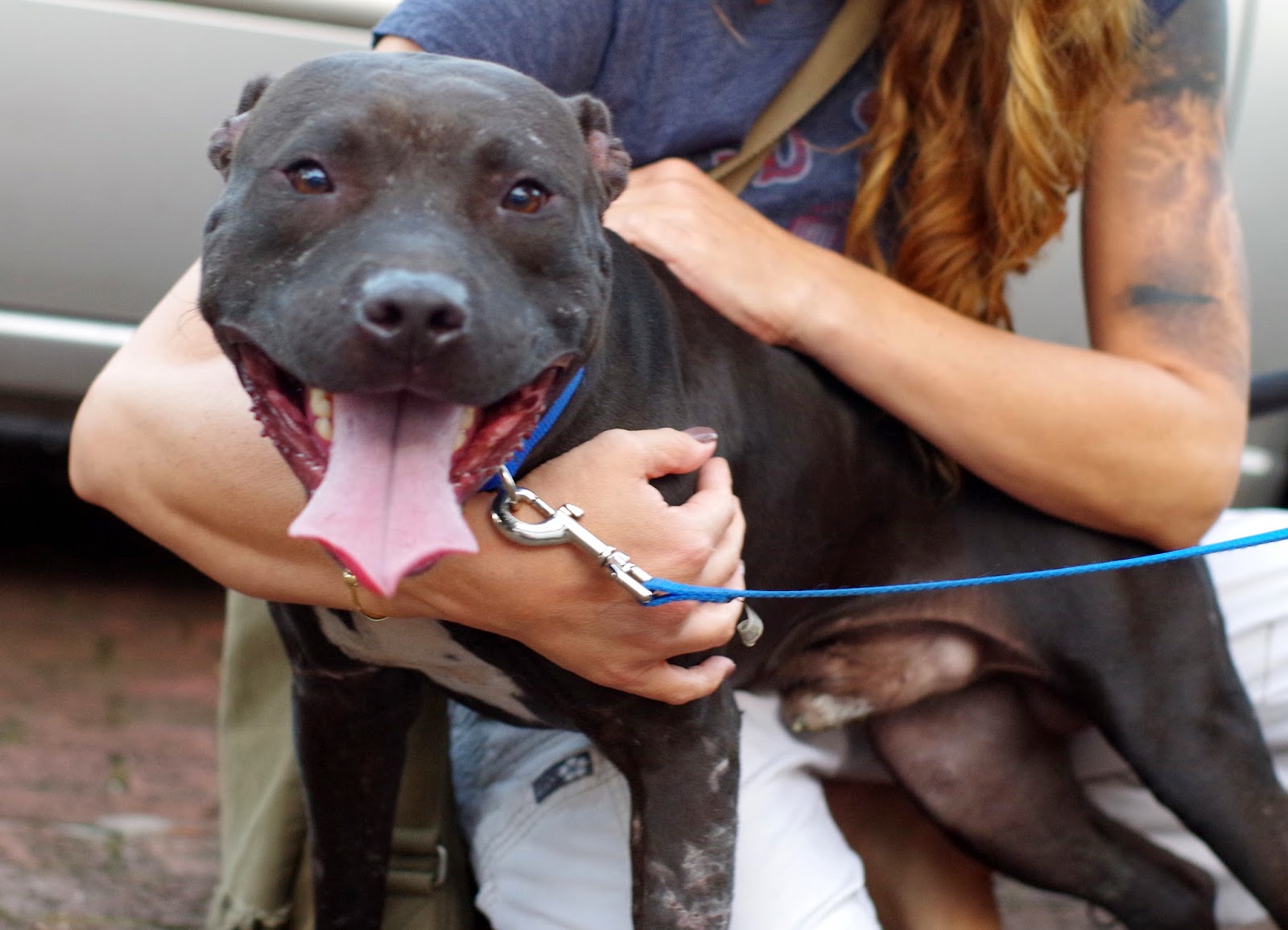
Here's the first in a series of posts about fostering and adopting some special dogs, beginning with the story of Stella, as told by her mom JoAnna.
I got very very lucky. I knew I wanted to foster as SOON as I was in an apartment of my own (my entire family did their best to dissuade me, stating that there was no way I could foster without trying to adopt my dogs. I was determined to prove them wrong - after all, I was in no position to adopt a dog at this point in my life! But I still needed to help somehow so I would foster and foster only).
I had always liked pit bulls (even though I never had much personal experience with them...although I made a mask in elementary school that was supposed to represent my interests and it had a feather, a Friesian horse, and an APBT on it) and since POPB seemed to be the only large-dog only rescue in the area I wanted to go with that, since I wanted to avoid small dogs at all costs. But I had seen a lot of nice seeming posts by Phoenix and someone I knew fostered for them, so I decided to go with them since I really wanted to get involved with a nice community comprised of sane people and that is what they appeared to be on the outside. As I was about to fill out the app for them, I got a very nice email from Rachel, encouraging me to submit a foster application. It was this email that saved me from falling into a horrible horrible situation, and I think almost weekly about how lucky I was that I was sucked into the wonderfulness that is POPB instead of another, less desirable rescue.
First, I was assigned to Annie. As luck would have it, dogs needed to be moved around and Pat didn't want Annie going anywhere until it was to her forever home so I got reassigned to Stella. I cracked up because I'd stalked Petfinder hard and I was aware that I went from the least pit bull-y looking dog possible to the most pit bull-y looking of our lineup. I found a cat that week that I was supposed to get her and I tried to delay getting Stella because she was not cat friendly. Luckily, Katie offered to house the cat for me until her people could be located (no such luck) or a home found. After much difficulty arranging a time to get Stella from Lacey (this was during my pre-car days), Lynne dropped her off with me. I brought the little wild thing up to my room and tried to decide if I should allow her on the bed. Stella solved that problem for me by making it the very first thing she did. (Since then, I can't sleep comfortably in that bed without Stella as my pillow/foot rest/space heater.) Stella sat up on my bed, offered me her paw, and smiled reaaaaally big. That was when I knew it was going to go well.
5 months later, her holiday foster wanted to adopt her. I was an anxious wreck for WEEKS trying to decide if this would be a good situation for her and trying to decipher how much of my hesitation was due to me being an overprotective first time foster mom and how much was legitimate concern. The wonderful team at POPB took my concerns into consideration and we eventually came to the conclusion that Stella would not be staying with her. As time passed, more and more evidence came to light that we absolutely made the correct decision. Not many rescues would take so much care to see if a home was worth it, especially for a difficult to place dog, and not many would listen to the foster home as carefully as POPB does. One night (while Stella was still with her temp foster/at that point possible adopter) I found out a little black pit that I had saved from traffic had been euthanized at ACAS (I tried to house the dog here but Stella was not having it and at that point I did not know how to manage her nearly as well as I do now). I sobbed and sobbed and did not have Stella with me to comfort me. That felt so wrong. Months later I would think back on a horse, Honey, that I had loved (and lost) in a similar situation to my current one with Stella (she was in no way mine and I couldn't make her mine and her future was uncertain because decisions about her were not mine to make) and Stella came over and gingerly climbed up on my lap and licked my tears and between my sobs I told her that I couldn't let her go. But I was lost because I knew that my future held extended trips out of the country to countries that would not allow pit bulls. I didn't know what to do. Lots of stress and fruitless begging of family members and periodic bouts of panic ensued. Sometime in this time period I would start to slip up and call her "my dog" instead of "my foster dog" and friends were shocked that she wasn't actually mine and my family members called her "JoAnna's dog."
Fast forward 11 months from the day that I started fostering her, and I got a phone call from my mom that I needed to go home, get Stella, and call her. She wouldn't tell me the news until I was with Stella. When I found out my dad had died, Stella was the only one there to comfort me. In the next few hours, she was as attentive and gentle with me as any human could have ever been. When I met up with the rest of my family, Stella not only comforted me but also did her best to show everyone some much needed unconditional love.
At one point my brother pointed out that Stella was shaking because I was, and everyone noticed that she would sit outside of the bathroom door, staring at it, as I showered, and that she invariably slept with as much of her body touching me as possible. The night before the funeral, my mom told me that she could not watch me go through what I went through with Honey again and that Stella was a "forever friend" to our family from that point on; I immiately wrote the board. My mom called up her landlord and told him that she was moving out because he didn't allow pets and she would have a granddog living with her soon (he told her he was going to make an exception for her until she told him the breed....knew I always hated him for a reason), since her daughter was going to Australia. She told all her siblings that they could expect to live with a pit bull when she/they go to take care of my Grandma, even though they have terrible close-minded opinions of pit bulls typical of the Detroit area. You'd think after 11 months of Stella not killing me in my sleep (as they predicted) they would be less judgmental, but nope. They need some immersion therapy with the real thing for that! She has already converted my uncle...the rest will follow suit.
I LOVE how my entire immediate family likes Stella and considers this a gain not just for me but for all of them as well. Chris constantly would cuddle her and must have told her what a good dog she was 20x in 5 days. As soon as Karl read about the murdered ACAS puppy he came right over to Stella and scooped her up and professed his love for her and the breed over and over and over, and then told Stella a bed time story about the time he carried a 45 lb pit bull named Tiny 5 miles out of the Hawaiian jungles on his shoulders after she was injured by a boar. Mary let Stella in her car and come over to her apartment without a crate and even let her onto her couch (a big deal for her). Steffi is overjoyed at having a new sister and can't wait to play more music to her and be silly with her. And my mom babies Stella more than anyone, even though the prey drive/reactivity is something completely foreign and intimidating to her. She is taking every opportunity to learn about management and actually listens to my explanation of behaviors (most people do not) and before anything else makes sure Stella is comfortable and happy and knows how much of a good baby she is. I love more than anything when those I love appreciate each other, and this is one of those cases. While Stella is in many ways the opposite of the black lab we had for 15 years growing up, she is becoming just as accepted by my family and that makes me almost as happy as Stella herself does. Stella is not without her challenges, which also means that I get to grow in my understanding of behavior and training and dogs in general as we work together on these things. I am very excited for a future with her.
Plus, I justify to myself, what kind of photographer can grow without a beautiful muse with soulful eyes for inspiration (who may or may not work for hot dogs).
- JoAnna Platzer
Sunday, July 5, 2015
The Story of Wilson
Who's Wilson? Our icon, muse, and favorite eye-patchy smiler. You see his face everywhere, but you might not know how he came to be the charismatic face of Plenty of Pit Bulls.
We asked Wilson's mom, Julie, to share the story.
One day back in January 2012, as we driving through our neighborhood, we saw a white dog skulking along the side of the road. He had a funny 'swingy' gait (sort of s-shaped, like a snake). We didn't stop as we just assumed he was 'attached' to his owner who was down the road somewhere. Then the next day we saw him again as we were out walking our two dogs - he was way ahead of us, turning a corner. We stopped to chat to a neighbor who said they had also seen the dog as it had camped out in their back yard the night before (they are not dog people, so they didn't go out to see him). So now we knew he was a stray.
Wilson, the night Julie and Craig found him
We finally get him into our back yard by throwing treats ahead of him and keeping hold of that lead. By this time it's 7.30pm on Saturday night. The vet is closed until Monday, ACAS is closed until Tuesday - he is clearly staying the night.
We decided to leave him outside in the yard so we didn't have to deal with him 'meeting' our two dogs. That didn't work. I was so worried he'd get out, I kept popping up every half and hour to see if he was still there - he was, in the same place every time, curled up in the dirt by the back gate. We decided that in the interests of sleep we should get him in the kitchen. Another 30 mins later we finally persuade him inside (my how the tables have turned, these days he will always choose the comfort of the AC over hanging out in the yard).
I can't totally remember the sequence of events from here but we took him to the vet and established he had no microchip, then posted pictures of him all over the place.
Nothing.
So we call ACAS on Tuesday and they come and get him. We watch them put him in the van, a bit teary eyed, and make sure to get his ID number so we can keep track of him over the next few days.
Nothing.
It's now Valentine's Day. As 'luck' would have it, his is 3-day hold is up, he's passed his temperament test but failed his health test (heartworm), which means he's going to be euthanized. Urgh.
Wilson in his Valentine's Day ribbon
My husband is away so I call him to discuss the situation. We agree we cannot let him die.
I send a message to the rescue from whom we had adopted our last dog. No reply, but someone called Anna jumps in and tells me that they have no spare fosters but if we would be willing to foster ourselves, she can arrange for him to be 'pulled' (lots of strange lingo in those early days).
Well. I absolutely did not want a third dog - even temporarily - but I couldn't see any alternative.
So on Wednesday February 14th 2012 I go to ACAS to rescue a dog. He is wild looking, filthy dirty and hyper. I felt like I'd bitten off more than I could chew (not a concern he shared, naturally).
That night, with this strange animal in a crate in the kitchen and my other two dogs sniffing furiously under the kitchen door, I sit down to watch Bridesmaids. I'm at the bit where the maid of honor is on her sofa watching 'Castaway'. Tom Hanks is drifting out to sea on a raft - and he wakes to realize that his only friend, Wilson the football, has come loose from the raft and is bobbing further and further away. 'Wilssssooooooon'.
And so he was named - Wilson - the castaway.
First week was a nightmare....
- Rotating dogs between house and yard, so we could introduce them the slow way (thank god that worked - he LOVES the two girls, though they wouldn't notice if he left tomorrow LOL).
- Trying to walk a wild animal who had clearly never had a lead put on, let alone been taken on a walk (he leapt and bound like a deer, dragging me behind him for a block before I decided enough was enough).
Right away we started doing adoption days (we were more than keen to revert to a two dog household) - only that was even more of a nightmare. He lunged and snarled at the other dogs from the moment he got out of the car at 11am until the moment he was put back in at 5pm. I spent hours standing by his crate, ready with the water spray, but after several such Saturdays we decided this wasn't the best place for him to be - too stressful for all concerned.
And so he became a social media dog.
He got lots of fans and lots of likes on his posts - but for some reason an entire year went by and nobody filled out an adoption form (I have come to believe he was writing spells during this time to conjure up a foster failure).
Then Anna got a spot at Petco for adoption events and we decided to try him again because he'd been doing so well at the Sunday training classes (courtesy of his amazing advocate, Kristy Schmidt). It took one weekend of being in Petco -- with Wilson being an angel in his crate and giving me the big eyes, as if to say "Mum - are we really having to do all this all over again?" -- for us to decide we'd rather spend our Saturdays hanging out with him on the patio than hanging out with him in Petco.
And so it came to pass that Wilson was officially adopted on April 1st 2014 - and is now living happily ever after in an air conditioned house in the Duckpond with his two sisters - what one might call a successful foster failure conjuring.
Happy Days from here on in
And fame to boot.
- Julie Knox
Saturday, June 27, 2015
Why pit bulls?
All kinds of dogs has many people who love the particularities that make them special. What makes us want to help pit bulls in particular?
It’s really not that they are better than other dogs, though certainly we are all pretty sure that our particular pit bulls might be the best ever.
But just loving your family members doesn’t make you an advocate. What is it about pit bulls that turns so many people who know and love them into activists?
First, they are the most in need. Anyone who volunteers with – or just visits – public shelters in our area quickly realize that a large proportion, often a sizable majority, of the dogs in need of rescue are pit bull types.
But need alone isn’t enough to make anyone commit. There has to be something positive as well. And pit bulls have lots going for them: their huge smiles, their goofy senses of humor, their constant need to be THISCLOSE to the people they love, their eagerness to figure things out, and their optimism about the future.
Granted, lots of dogs have those qualities. Possibly the most important thing about pit bulls is the gap between the lovable, ordinary dogs that we know and the fear, hatred, and discrimination that they often face.
Lots of people love Golden Retrievers, or Cocker Spaniels, or St. Bernards. There’s nothing wrong with that. And no one ever tells you that you’re brave, or foolish, or even thuggish because you love your dog.
It’s different with a pit bull.
Your activism might start the first time an apartment complex prohibits your family member, or someone crosses the street to avoid your happy, outgoing dog, or a relative tells you to keep your pit bull away from your new baby, or you discover that you can’t take a road trip through Denver because your dog could be taken away from you.
You start out telling your mom not to worry about the baby, or telling your neighbor “he’s friendly,” and before you know it you’re a full-fledged pit bull activist.
The best part about pit bull advocacy is the dogs, of course. But after that, it’s surely the people. And that’s because what holds us together is not anger or fear, but love.
Friday, June 26, 2015
A Short History of Plenty of Pit Bulls
How we started....
Plenty of Pit Bulls got its start in 2010 with a small group of volunteers connected with our local public shelter, Alachua County Animal Services (ACAS) and private rescue organizations. We started looking for ways to increase the number of pit bulls rescued and adopted in our area. We were very loosely organized, but we looked for ways to help by initiating pit bull specific events and programs at the shelter and elsewhere, providing information about pit bulls, and making it possible for rescues to pull pit bulls from the shelter euthanasia lists by recruiting foster homes and providing sponsorship. We often paid the pull fee – back in those days, ACAS charged rescue groups the same as adopters to pull an adoptable dog – and back in those days, ACAS euthanized far, far more adoptable dogs than it does now.
And where did that name come from?
“Plenty of Pit Bulls” is a riff on the term “plentiful pit bulls,” which was a program offering reduced adoption fees for pit bulls at the shelter. The author of that immortal phrase is Hilary Hynes, the shelter’s education coordinator and one of our favorite people in the animal welfare and rescue world.
Hilary Hynes, standing with ACAS alum (and cruelty and heartworm survivor)
Teddy and his proud family after Teddy passed the Canine Good Citizen Test.
POPB resisted getting very organized for a couple of years. With so many outstanding rescue groups in Gainesville already, we didn’t see a need to create a separate rescue group. We figured our energies were best used in strengthening and expanding the capacity of the existing rescues.
In early 2012, we decided to take the momentous (had we only known) step of registering as a Florida nonprofit corporation, to have legal status as a community organization. The Florida incorporation made it possible for us to take the next step: pulling dogs directly from the shelter ourselves, rather than collaborating with other rescues.
Our first pull was, ironically, not a pit bull at all, but a retriever-y looking black mutt whom we named Tucker. He was placed on the ACAS euthanasia list in spring 2012 and when no other rescue took him, we decided to plunge in. Beginner’s luck meant that he was adopted almost immediately by a fabulous young couple. They changed his name to Gatsby, because he is so great.
Still, most of what we did was provide support for other rescues in the area, to make it possible for them to save dogs whom they otherwise wouldn’t have been able to take. We collaborated with many groups, including the Alachua County Humane Society, Second Chance, Helping Hands, Puppy Hill Farm, and more. And we continued to have strong ties to ACAS and the staff and volunteers there.
That collaborative experience stood us well, and we continue to team up with other rescues and shelters whenever possible. We think this is one of the things that makes POPB special. We know it takes many pieces to save a dog, and sometimes the missing piece is something that we don’t have, but someone else does – or vice-versa. Our collaborative radius has expanded, but our commitment to having a big tent remains the same.
While most of our dogs were still placed for adoption by other rescues, bit by bit we added dogs of “our own.” Some of the early ones included the Ella the Pit Bull Princess and our first cruelty case dogs, Roxie and Opie (Opie was adopted through HHR). We also started working with volunteers at other shelters. Our first non-Alachua pulls were from Levy County, including one of everyone’s all-time favorites, Harper.
Because we grew into being a full-fledged rescue group slowly, we learned a lot by trial and error along the way. We ended up doing a lot of things that we didn’t really intend to do when we started – like pull dogs on our own, work outside Alachua county, and apply for 501(c)(3) status. We grew organically, expanding our scope because we saw gaps that we could fill and because we had volunteers who could make it happen.
We were and still are all-volunteer. Our early volunteers were all people who had been working with other shelters and rescues but had a special love for big-headed dogs. As we solidified, we started to draw new volunteers who were attracted to working for a pit bull specific rescue.
This growing corp of volunteers made it possible for us to help dogs from a growing number of shelters. In January 2013, we pulled our first dog from Putnam County Animal Services, a severely emaciated, scarred, and heartworm positive red girl named Nova
This was a very meaningful pull for us because Putnam County has a long history of discrimination against pit bulls. They used to euthanize all dogs that their staff identified as pit bulls automatically, and then they changed their policy to allow “pit bulls” to be pulled by rescues. They still do not permit them to be adopted directly by the public. This is the kind of discrimination that kills dogs – not only by reducing their chances, but also by placing them in a separate category that makes them seem different from other dogs.
We have a soft spot not only for pit bulls, but for dogs from cruelty cases. Since Roxie and Opie, we have taken probably dozens of dogs from ACAS cruelty confiscations, including two of our favorites, Ronny and Izzy. Ronny was adopted by his foster mom Hagar, a vet student, and Izzy found a fabulous home with a law student.
We could help dogs like Ronny and Izzy because of the relationship we have with the Veterinary Community Outreach Program (formerly Shelter Medicine) at the University of Florida. There is no way that we (or most of the rescue groups in our area) could function without this program. They spay and neuter our dogs and also provide care for a number of common health issues, including demodex and heartworm. They also visit other area shelters, and sometimes they identify wonderful dogs that they would like to help. We’ve gotten some of our favorite dogs this way – we call them “Isaza specials,” in honor of VCOP vet Dr Natalie Isaza.
As we grew, we realized that our lack of 503(c)(3) status was limiting our options in terms of adoption venues, grant opportunities, donations, and more. In May 2013 we applied for 501(c)(3) status, and about 13 months later we got the approval letter from the IRS. It felt like Plenty of Pit Bulls was finally all grown up.
Soon after we received the 501(c)(3) status, we began to work on our first national cruelty case. 367 dogs were seized from dog fighting rings in August 2013, in the second largest fight bust in US history. The dogs were divided up between the ASPCA and HSUS to be cared for while the legal case. POPB volunteers worked closely with the ASPCA to place as many dogs as possible from this case. Our first #367 dog was Arabelle, who was released early (in October 2013) due to health problems. She was adopted by her foster mom Sharon Nataline, a POPB founding board member, and lives the good life with a home full of geriatric chihuahuas and other big personalities.
We ultimately were able to take in and place 17 of the #367 dogs, more than any other rescue in the country. Most of those were adopted locally, but two crossed state lines to find very special homes – Finn in New Jersey and Ruby in Illinois.
In May 2014, Orange County Animal Services took in several dozen several dogs from a fight bust in Apopka. When the dogs were legally released in August of that year, we were able to take in several, including rock star Olivia, who is now an official Canine Good Citizen and a registered therapy dog.
Olivia's mom Caroline is one of our many adopters who have gone from falling
in love with one particular pit bull to becoming whole-hearted and creative
advocates for big-headed dogs everywhere.
One of the reasons we initially shied away from becoming a full-fledged rescue organization was that we were worried about not having time to do other activities, such as education, advocacy, and shelter support. While there is never enough time or money to do all we would like, we’ve found that rescuing individual dogs can reinforce and strengthen those other activities, and vice-versa. Dogs like Arabelle, Olivia, Ronny, and Ella are the best possible educators and marketing geniuses. They change minds and open hearts just by being who they are – affectionate, smart, outgoing, resilient, and somewhat goofy blockheads.
And some of the volunteers who are first attracted to the opportunity of working with individual dogs in a hands-on way often become interested in helping spread the word about how wonderful these dogs are, how cruel breed discrimination is, and how fun and rewarding it is to work in a community of like-minded dog-lovers.
Plenty of Pit Bulls got its start in 2010 with a small group of volunteers connected with our local public shelter, Alachua County Animal Services (ACAS) and private rescue organizations. We started looking for ways to increase the number of pit bulls rescued and adopted in our area. We were very loosely organized, but we looked for ways to help by initiating pit bull specific events and programs at the shelter and elsewhere, providing information about pit bulls, and making it possible for rescues to pull pit bulls from the shelter euthanasia lists by recruiting foster homes and providing sponsorship. We often paid the pull fee – back in those days, ACAS charged rescue groups the same as adopters to pull an adoptable dog – and back in those days, ACAS euthanized far, far more adoptable dogs than it does now.
And where did that name come from?
“Plenty of Pit Bulls” is a riff on the term “plentiful pit bulls,” which was a program offering reduced adoption fees for pit bulls at the shelter. The author of that immortal phrase is Hilary Hynes, the shelter’s education coordinator and one of our favorite people in the animal welfare and rescue world.
Hilary Hynes, standing with ACAS alum (and cruelty and heartworm survivor)
Teddy and his proud family after Teddy passed the Canine Good Citizen Test.
POPB resisted getting very organized for a couple of years. With so many outstanding rescue groups in Gainesville already, we didn’t see a need to create a separate rescue group. We figured our energies were best used in strengthening and expanding the capacity of the existing rescues.
In early 2012, we decided to take the momentous (had we only known) step of registering as a Florida nonprofit corporation, to have legal status as a community organization. The Florida incorporation made it possible for us to take the next step: pulling dogs directly from the shelter ourselves, rather than collaborating with other rescues.
Our first pull was, ironically, not a pit bull at all, but a retriever-y looking black mutt whom we named Tucker. He was placed on the ACAS euthanasia list in spring 2012 and when no other rescue took him, we decided to plunge in. Beginner’s luck meant that he was adopted almost immediately by a fabulous young couple. They changed his name to Gatsby, because he is so great.
That collaborative experience stood us well, and we continue to team up with other rescues and shelters whenever possible. We think this is one of the things that makes POPB special. We know it takes many pieces to save a dog, and sometimes the missing piece is something that we don’t have, but someone else does – or vice-versa. Our collaborative radius has expanded, but our commitment to having a big tent remains the same.
While most of our dogs were still placed for adoption by other rescues, bit by bit we added dogs of “our own.” Some of the early ones included the Ella the Pit Bull Princess and our first cruelty case dogs, Roxie and Opie (Opie was adopted through HHR). We also started working with volunteers at other shelters. Our first non-Alachua pulls were from Levy County, including one of everyone’s all-time favorites, Harper.
Because we grew into being a full-fledged rescue group slowly, we learned a lot by trial and error along the way. We ended up doing a lot of things that we didn’t really intend to do when we started – like pull dogs on our own, work outside Alachua county, and apply for 501(c)(3) status. We grew organically, expanding our scope because we saw gaps that we could fill and because we had volunteers who could make it happen.
We were and still are all-volunteer. Our early volunteers were all people who had been working with other shelters and rescues but had a special love for big-headed dogs. As we solidified, we started to draw new volunteers who were attracted to working for a pit bull specific rescue.
This growing corp of volunteers made it possible for us to help dogs from a growing number of shelters. In January 2013, we pulled our first dog from Putnam County Animal Services, a severely emaciated, scarred, and heartworm positive red girl named Nova
This was a very meaningful pull for us because Putnam County has a long history of discrimination against pit bulls. They used to euthanize all dogs that their staff identified as pit bulls automatically, and then they changed their policy to allow “pit bulls” to be pulled by rescues. They still do not permit them to be adopted directly by the public. This is the kind of discrimination that kills dogs – not only by reducing their chances, but also by placing them in a separate category that makes them seem different from other dogs.
We have a soft spot not only for pit bulls, but for dogs from cruelty cases. Since Roxie and Opie, we have taken probably dozens of dogs from ACAS cruelty confiscations, including two of our favorites, Ronny and Izzy. Ronny was adopted by his foster mom Hagar, a vet student, and Izzy found a fabulous home with a law student.
We could help dogs like Ronny and Izzy because of the relationship we have with the Veterinary Community Outreach Program (formerly Shelter Medicine) at the University of Florida. There is no way that we (or most of the rescue groups in our area) could function without this program. They spay and neuter our dogs and also provide care for a number of common health issues, including demodex and heartworm. They also visit other area shelters, and sometimes they identify wonderful dogs that they would like to help. We’ve gotten some of our favorite dogs this way – we call them “Isaza specials,” in honor of VCOP vet Dr Natalie Isaza.
As we grew, we realized that our lack of 503(c)(3) status was limiting our options in terms of adoption venues, grant opportunities, donations, and more. In May 2013 we applied for 501(c)(3) status, and about 13 months later we got the approval letter from the IRS. It felt like Plenty of Pit Bulls was finally all grown up.
Soon after we received the 501(c)(3) status, we began to work on our first national cruelty case. 367 dogs were seized from dog fighting rings in August 2013, in the second largest fight bust in US history. The dogs were divided up between the ASPCA and HSUS to be cared for while the legal case. POPB volunteers worked closely with the ASPCA to place as many dogs as possible from this case. Our first #367 dog was Arabelle, who was released early (in October 2013) due to health problems. She was adopted by her foster mom Sharon Nataline, a POPB founding board member, and lives the good life with a home full of geriatric chihuahuas and other big personalities.
We ultimately were able to take in and place 17 of the #367 dogs, more than any other rescue in the country. Most of those were adopted locally, but two crossed state lines to find very special homes – Finn in New Jersey and Ruby in Illinois.
In May 2014, Orange County Animal Services took in several dozen several dogs from a fight bust in Apopka. When the dogs were legally released in August of that year, we were able to take in several, including rock star Olivia, who is now an official Canine Good Citizen and a registered therapy dog.
Olivia's mom Caroline is one of our many adopters who have gone from falling
in love with one particular pit bull to becoming whole-hearted and creative
advocates for big-headed dogs everywhere.
One of the reasons we initially shied away from becoming a full-fledged rescue organization was that we were worried about not having time to do other activities, such as education, advocacy, and shelter support. While there is never enough time or money to do all we would like, we’ve found that rescuing individual dogs can reinforce and strengthen those other activities, and vice-versa. Dogs like Arabelle, Olivia, Ronny, and Ella are the best possible educators and marketing geniuses. They change minds and open hearts just by being who they are – affectionate, smart, outgoing, resilient, and somewhat goofy blockheads.
And some of the volunteers who are first attracted to the opportunity of working with individual dogs in a hands-on way often become interested in helping spread the word about how wonderful these dogs are, how cruel breed discrimination is, and how fun and rewarding it is to work in a community of like-minded dog-lovers.
Tuesday, May 6, 2014
Dog fighting
Dog fighting happens. It happens less often than some people fear, but far more often than many of us wish. Dog fighting, like other “blood sports,” has been part of many different cultures around the world, for many centuries. In his fascinating book Dogs: A Dictionary of Dog Breeds (2002), Desmond Morris lists 27 different breeds that were selected, bred, and used mainly for fighting, including not only most of the “pit bull” type dogs (American Pit Bull Terriers, American Staffordshire Terriers, Staffordshire Terriers, Bull Terriers, and American Bulldogs) but also Japanese Akitas, Chinese Shar Peis, and many mastiff type dogs from all over the world.
Morris writes, “Dog-fighting is a dark chapter in the history of man’s long relationship with the canine world, and there may be some who feel that those breeds that were exclusively developed for fighting should not be included in a modern reference work such as this one. But the fact is that they were part of dog history and cannot be ignored (340). More specifically, fighting is part of the history and also the present of the particular dogs that we know and love.
Presently dog fighting harms tens of thousands of dogs, mainly pit bulls, every year in the US. It happens all over the country, in rural, suburban, and urban areas, and with participants from many different socio-econ groups. It certainly happens in north central Florida, and shelters and rescue groups regularly receive dogs who show signs of having participated in organized fighting. (It’s important to note, however, that of the many dogs who show up at shelters badly injured, few were likely used as “bait” dogs. Some were, of course, but there are many ways that dogs get hurt, including ordinary fights between “non professionals,” so we should be careful about leaping to conclusions about the history of any dog, especially those encountered as strays.)
Today local and national law enforcement authorities take dog fighting very seriously and often pursue it vigorously – both for the animal cruelty involved and because dog fighters are frequently involved in other crimes as well. In the past couple of years, the FBI and other law enforcement agencies have worked with national animal welfare organizations (especially the ASPCA and Humane Society of the US) on several huge raids on dog fighting rings. The largest, in Missouri in 2012, took in over 400 dogs, and the second largest, in several southern states in August 2013, took in 367.
Not long ago, all dogs seized in raids were euthanized as soon as their legal role as evidence was finished. Today, many are evaluated individually and treated as victims and not criminals. This change in policy is due largely to the efforts of pit bull advocates involved in helping the dogs from Michael Vick’s fighting ring, including BAD RAP and Best Friends. Individual evaluations and rehabilitation efforts have made it possible for many dogs from fighting backgrounds to become beloved family pets, therapy dogs, canine athletes, and more.
Pit bull rescue, and the rescue of dogs from fighting rings in particular, is the edge of animal rescue and welfare today. Pit bull type dogs are discriminated against in part because of their perceived association with dog fighting and other criminal activities, and pit bull advocates need to address these associations head on and show – not just argue – that these dogs deserve a chance.
Our own experiences with dogs from fighting backgrounds have been positive and often surprising. Almost all have been extremely human-oriented, affectionate, and outgoing – which is not the surprising part, since in that regard, they are typical pit bulls. What is surprising is how easily most have adjusted to life as family pets and also how well many of them get along with other animals, including dogs and also cats.
Work with dogs from fighting backgrounds reinforces the wisdom of treating ever dog as an individual. Some dogs from fighting pasts are timid around new people or reactive with new dogs — but not any more than other dogs we meet. The same is true of dogs that we’ve taken from cruelty cases and confiscations. They all respond to trauma differently, and making generalizations is not accurate — and it doesn’t help us get to know the dogs or help them. What defines a dog is not “all how they’re raised,” in other words, but a combination of nature, nurture, and ongoing care and management.
While vigorous law enforcement is crucial, the other key to ending dogfighting is education. The most effective educators, of course, are the dogs themselves.
Morris writes, “Dog-fighting is a dark chapter in the history of man’s long relationship with the canine world, and there may be some who feel that those breeds that were exclusively developed for fighting should not be included in a modern reference work such as this one. But the fact is that they were part of dog history and cannot be ignored (340). More specifically, fighting is part of the history and also the present of the particular dogs that we know and love.
Presently dog fighting harms tens of thousands of dogs, mainly pit bulls, every year in the US. It happens all over the country, in rural, suburban, and urban areas, and with participants from many different socio-econ groups. It certainly happens in north central Florida, and shelters and rescue groups regularly receive dogs who show signs of having participated in organized fighting. (It’s important to note, however, that of the many dogs who show up at shelters badly injured, few were likely used as “bait” dogs. Some were, of course, but there are many ways that dogs get hurt, including ordinary fights between “non professionals,” so we should be careful about leaping to conclusions about the history of any dog, especially those encountered as strays.)
Today local and national law enforcement authorities take dog fighting very seriously and often pursue it vigorously – both for the animal cruelty involved and because dog fighters are frequently involved in other crimes as well. In the past couple of years, the FBI and other law enforcement agencies have worked with national animal welfare organizations (especially the ASPCA and Humane Society of the US) on several huge raids on dog fighting rings. The largest, in Missouri in 2012, took in over 400 dogs, and the second largest, in several southern states in August 2013, took in 367.
Not long ago, all dogs seized in raids were euthanized as soon as their legal role as evidence was finished. Today, many are evaluated individually and treated as victims and not criminals. This change in policy is due largely to the efforts of pit bull advocates involved in helping the dogs from Michael Vick’s fighting ring, including BAD RAP and Best Friends. Individual evaluations and rehabilitation efforts have made it possible for many dogs from fighting backgrounds to become beloved family pets, therapy dogs, canine athletes, and more.
Pit bull rescue, and the rescue of dogs from fighting rings in particular, is the edge of animal rescue and welfare today. Pit bull type dogs are discriminated against in part because of their perceived association with dog fighting and other criminal activities, and pit bull advocates need to address these associations head on and show – not just argue – that these dogs deserve a chance.
Our own experiences with dogs from fighting backgrounds have been positive and often surprising. Almost all have been extremely human-oriented, affectionate, and outgoing – which is not the surprising part, since in that regard, they are typical pit bulls. What is surprising is how easily most have adjusted to life as family pets and also how well many of them get along with other animals, including dogs and also cats.
Work with dogs from fighting backgrounds reinforces the wisdom of treating ever dog as an individual. Some dogs from fighting pasts are timid around new people or reactive with new dogs — but not any more than other dogs we meet. The same is true of dogs that we’ve taken from cruelty cases and confiscations. They all respond to trauma differently, and making generalizations is not accurate — and it doesn’t help us get to know the dogs or help them. What defines a dog is not “all how they’re raised,” in other words, but a combination of nature, nurture, and ongoing care and management.
While vigorous law enforcement is crucial, the other key to ending dogfighting is education. The most effective educators, of course, are the dogs themselves.
Friday, February 7, 2014
Goodbye, Eddie
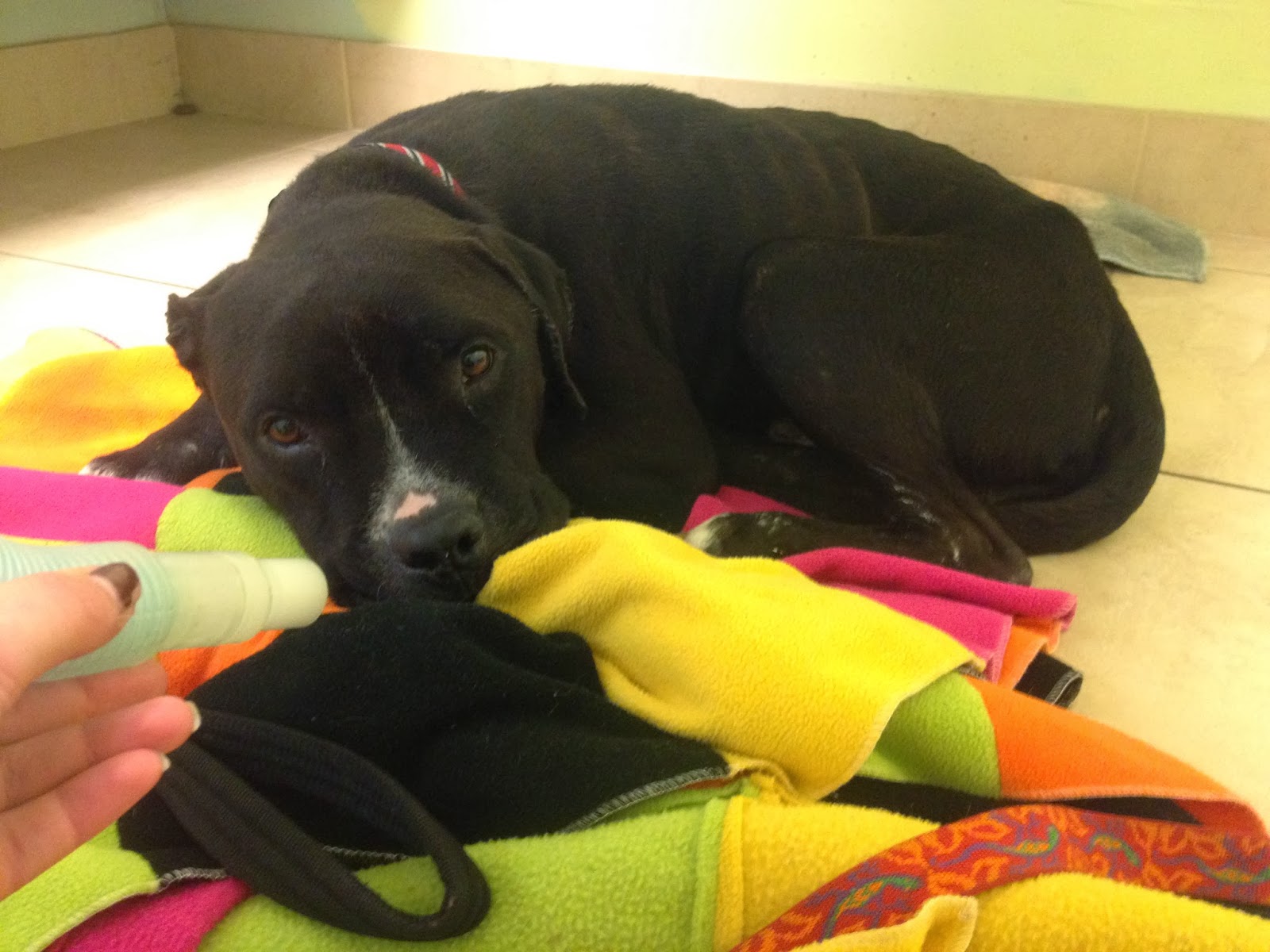
We pulled Eddie from Clay County Animal Services on Friday, Jan. 17. He was thin and heartworm positive, but most of our dogs start out that way. Eddie’s foster mom, Kayla, had plenty of experience with sickly dogs and we were confident Eddie would be another success story. However, the day after we brought Eddie home, he became extremely anemic and lethargic. Late on Saturday night, Kayla rushed him to the emergency vet, where he received a blood transfusion. That one didn’t improve his condition significantly, and on Monday he received another transfusion at our regular vet, Dr Allison Schnoke at Archer Animal Hospital. She did further tests and determined that he was suffering from Immune Mediated Hemolytic Anemia (IMHA), a condition in which the patient’s own immune system attacks his red blood cells. This is a very serious condition, with high mortality rates even in otherwise healthy dogs. Eddie’s malnutrition and heartworm status made his situation even more dangerous. However, the second transfusion and additional medication seemed to do the trick, and Eddie seemed to turn the corner. Eddie’s vet bills from those couple of days were over $1700, but generous donors made it possible for us to do everything the vets recommended. Dr Schnoke called him our miracle dog. Eddie went home and steadily improved over the next couple of weeks, gaining weight and energy. After additional veterinary consultations, we felt confident in scheduling his heartworm treatment to begin in mid-February.
Early this morning, Eddie took a sudden turn for the worse and went back to the vet first thing this morning. Throughout the day his blood levels and his well-being steadily declined. He was again extremely anemic and suffering. Dr Schnoke tried to stabilize him, conducted additional tests, and consulted specialists. She researched all the possible options, including exploratory surgery, additional medications, and additional transfusions. She knew that we were prepared to do anything that might save his life and make it possible for him to recover enough to undergo heartworm treatment. Sadly, this relapse was worse than the initial crisis, and after a long, difficult day, during which Eddie became increasingly uncomfortable, we were forced to the conclusion that we were out of medical options. He just could not be saved, even with all the resources available.
We were prepared to do anything that might save his life. This is something many of us take for granted in regards to our own dogs, but when we are talking about shelter or foster dogs, we think twice. It’s hard to know how many resources to devote to a single homeless dog when the money spent on extraordinary vet care could, in principle, help multiple dogs. A strict Utilitarian ethic – aimed at maximizing welfare for the largest number of individuals – would probably tell us not to go to extreme lengths for a single animal. In the end, the cost of Eddie’s vet care will total well over $2000, perhaps closer to $2500. That’s a lot of money for a small rescue group.
I’m sensitive to the welfare-maximization argument, but there’s another ethical perspective that I also find compelling. When we pulled Eddie from a low-resource, high-kill rural shelter, he stopped being a “homeless dog” and became one of our own. We committed to treating him as though he mattered. That’s not to say all the dogs left behind don’t matter – they do – but we can’t pull them all. We are constantly doing cost/benefit calculations, trying to match resources to needs, figuring out how to maximize the good we can do with very limited resources.
When we pull a dog, however, we cease being Utilitarians and instead become Kantians (of a particularly quirky and subversive sort). Our guiding principle becomes not the maximization of welfare but the commitment to treat every individual as an end in himself, not just a means to a larger good.
In the case of Eddie, this meant pulling out all the veterinary and fiscal stops. That was the only course that respected his intrinsic value – his personhood, if you will. It was expensive, and in the end it wasn’t enough. However, Eddie got what my own dogs would get: total commitment, unwavering hope, and endless love.
Some people think that it contradicts or undermines the goals of rescue to devote all that to a single dog. To the contrary, I think that this is precisely the meaning of rescue: we give to this dog what every dog should have. At least for a few short weeks, his life embodied the world we want for every dog and every human.
We loved you the most, little guy.
Early this morning, Eddie took a sudden turn for the worse and went back to the vet first thing this morning. Throughout the day his blood levels and his well-being steadily declined. He was again extremely anemic and suffering. Dr Schnoke tried to stabilize him, conducted additional tests, and consulted specialists. She researched all the possible options, including exploratory surgery, additional medications, and additional transfusions. She knew that we were prepared to do anything that might save his life and make it possible for him to recover enough to undergo heartworm treatment. Sadly, this relapse was worse than the initial crisis, and after a long, difficult day, during which Eddie became increasingly uncomfortable, we were forced to the conclusion that we were out of medical options. He just could not be saved, even with all the resources available.
We were prepared to do anything that might save his life. This is something many of us take for granted in regards to our own dogs, but when we are talking about shelter or foster dogs, we think twice. It’s hard to know how many resources to devote to a single homeless dog when the money spent on extraordinary vet care could, in principle, help multiple dogs. A strict Utilitarian ethic – aimed at maximizing welfare for the largest number of individuals – would probably tell us not to go to extreme lengths for a single animal. In the end, the cost of Eddie’s vet care will total well over $2000, perhaps closer to $2500. That’s a lot of money for a small rescue group.
I’m sensitive to the welfare-maximization argument, but there’s another ethical perspective that I also find compelling. When we pulled Eddie from a low-resource, high-kill rural shelter, he stopped being a “homeless dog” and became one of our own. We committed to treating him as though he mattered. That’s not to say all the dogs left behind don’t matter – they do – but we can’t pull them all. We are constantly doing cost/benefit calculations, trying to match resources to needs, figuring out how to maximize the good we can do with very limited resources.
When we pull a dog, however, we cease being Utilitarians and instead become Kantians (of a particularly quirky and subversive sort). Our guiding principle becomes not the maximization of welfare but the commitment to treat every individual as an end in himself, not just a means to a larger good.
In the case of Eddie, this meant pulling out all the veterinary and fiscal stops. That was the only course that respected his intrinsic value – his personhood, if you will. It was expensive, and in the end it wasn’t enough. However, Eddie got what my own dogs would get: total commitment, unwavering hope, and endless love.
Some people think that it contradicts or undermines the goals of rescue to devote all that to a single dog. To the contrary, I think that this is precisely the meaning of rescue: we give to this dog what every dog should have. At least for a few short weeks, his life embodied the world we want for every dog and every human.
We loved you the most, little guy.
Saturday, October 5, 2013
It takes a community
This past week, we’ve been reminded again and again that the power of human solidarity is what makes it possible for us to help dogs in need.
First up, Caroline. This beautiful young dog has been at Clay Co. Animal Services for a while, and when she developed skin allergies, a volunteer started fostering her. The foster wanted to make sure that she would be adopted to a home that would continue to treat her health problems, so she looked for a private rescue that would be able to vet adoption applications carefully. Another Clay volunteer put her in touch with us, and when we explained that we were both full and broke, she made an offer we couldn’t refuse: she would cover vet costs and foster until adoption. We get dozens of requests to help nice dogs every month – sometimes it seems like dozens every week. This time, one persons’ absolute commitment to a dog – and the shelter volunteer’s ability to put her in touch with us – made the difference.
Speaking of absolute commitment, no one embodies it like Beth Reeb. She has fostered for us before and is 100% solid, so when she talks, we listen. Beth met Belle at Putnam Co. Animal Services (like Clay, a rural shelter with few resources and few adopters) and fell in love. We told Beth that we are broke and full, and she asked what it would take to save Belle. What it took was donations, a commitment to foster, and collaboration with a rescue group in Putnam Co., Their Lives, Our Voices, who can help with local vetting and adoption events. Beth put it together and got Belle the next day. Again, it takes a combination of a committed and generous individual (or two) and collaboration between organizations.
Dogs like Caroline and Belle – at high-kill rural shelters – don’t often have happy endings, even when they are as beautiful, young, friendly, and well-behaved as these two. Another dog we’ve just been able to help had even lower odds. Arabelle is one of the first dogs released from the second largest dog fighting raid in U.S. history, in which hundreds of dogs were confiscated in several southern states. We are honored to be collaborating with the ASPCA in this incredible case. She is older and has some minor health issues but she is a happy dog and we are delighted to be able to offer her comfort and love for as long as we have her. Again, networking – in this case with a national animal welfare organization – and a committed foster made the difference.
Then there's Goose. This little guy -- who probably should be a big guy -- came to our attention because of those same incredible Clay volunteers who never, never give up on the dogs they love. Because we love to work with Clay volunteers and because our Clay dogs have been amazing, we decided to meet him, with the thought that maybe in a few weeks, when we had room, we could take him into our program. We knew he was heartworm positive, which meant that he would not need to worry about adoption for a couple of months. So our most intrepid volunteer headed to the Animal Expo at Clay to meet him today, only to find that he had been taken to No More Homeless Pets in Jacksonville because he had started coughing blood. When she got there, she was told that he had been taken to a vet office for further tests. (That's why we call him Goose -- because it took a wild goose chase to track him down!) It turns out that he is suffering not only from heartworm but also pneumonia. In addition, he is 10-15 lbs. underweight, his teeth appear to have been filed down, and he has some other dental problems as well. However, in true pit bull fashion, he just wants to climb into your lap. And of course, he's coming home with Lacey and will be getting round-the-clock vet care. We're not sure how it will go, but if we have anything to say about it, he'll make it.
Last up (for this week) is a little brown dog without a name. We received an email from a woman who was worried about her neighbor’s dog, who was emaciated, nursing puppies, and confined to a small, dirty pen. We were in contact with her and working on communicating with Animal Services to see what could be done when the neighbor told us the adult dog was gone. Within hours, we saw a post on Gainesville Pet Finder about an emaciated brown pit bull who had been found by a very kind and generous woman. The finder took the dog to the vet and then posted her picture to see if someone was looking for her. We put two and two together – or rather, put the neighbor and the finder together, and it turned out to be the same dog. The dog is safe now and we are consulting with Animal Services to find how to keep the dog (and her pups, if possible) safe permanently.
First up, Caroline. This beautiful young dog has been at Clay Co. Animal Services for a while, and when she developed skin allergies, a volunteer started fostering her. The foster wanted to make sure that she would be adopted to a home that would continue to treat her health problems, so she looked for a private rescue that would be able to vet adoption applications carefully. Another Clay volunteer put her in touch with us, and when we explained that we were both full and broke, she made an offer we couldn’t refuse: she would cover vet costs and foster until adoption. We get dozens of requests to help nice dogs every month – sometimes it seems like dozens every week. This time, one persons’ absolute commitment to a dog – and the shelter volunteer’s ability to put her in touch with us – made the difference.
Speaking of absolute commitment, no one embodies it like Beth Reeb. She has fostered for us before and is 100% solid, so when she talks, we listen. Beth met Belle at Putnam Co. Animal Services (like Clay, a rural shelter with few resources and few adopters) and fell in love. We told Beth that we are broke and full, and she asked what it would take to save Belle. What it took was donations, a commitment to foster, and collaboration with a rescue group in Putnam Co., Their Lives, Our Voices, who can help with local vetting and adoption events. Beth put it together and got Belle the next day. Again, it takes a combination of a committed and generous individual (or two) and collaboration between organizations.
Dogs like Caroline and Belle – at high-kill rural shelters – don’t often have happy endings, even when they are as beautiful, young, friendly, and well-behaved as these two. Another dog we’ve just been able to help had even lower odds. Arabelle is one of the first dogs released from the second largest dog fighting raid in U.S. history, in which hundreds of dogs were confiscated in several southern states. We are honored to be collaborating with the ASPCA in this incredible case. She is older and has some minor health issues but she is a happy dog and we are delighted to be able to offer her comfort and love for as long as we have her. Again, networking – in this case with a national animal welfare organization – and a committed foster made the difference.
Then there's Goose. This little guy -- who probably should be a big guy -- came to our attention because of those same incredible Clay volunteers who never, never give up on the dogs they love. Because we love to work with Clay volunteers and because our Clay dogs have been amazing, we decided to meet him, with the thought that maybe in a few weeks, when we had room, we could take him into our program. We knew he was heartworm positive, which meant that he would not need to worry about adoption for a couple of months. So our most intrepid volunteer headed to the Animal Expo at Clay to meet him today, only to find that he had been taken to No More Homeless Pets in Jacksonville because he had started coughing blood. When she got there, she was told that he had been taken to a vet office for further tests. (That's why we call him Goose -- because it took a wild goose chase to track him down!) It turns out that he is suffering not only from heartworm but also pneumonia. In addition, he is 10-15 lbs. underweight, his teeth appear to have been filed down, and he has some other dental problems as well. However, in true pit bull fashion, he just wants to climb into your lap. And of course, he's coming home with Lacey and will be getting round-the-clock vet care. We're not sure how it will go, but if we have anything to say about it, he'll make it.
Last up (for this week) is a little brown dog without a name. We received an email from a woman who was worried about her neighbor’s dog, who was emaciated, nursing puppies, and confined to a small, dirty pen. We were in contact with her and working on communicating with Animal Services to see what could be done when the neighbor told us the adult dog was gone. Within hours, we saw a post on Gainesville Pet Finder about an emaciated brown pit bull who had been found by a very kind and generous woman. The finder took the dog to the vet and then posted her picture to see if someone was looking for her. We put two and two together – or rather, put the neighbor and the finder together, and it turned out to be the same dog. The dog is safe now and we are consulting with Animal Services to find how to keep the dog (and her pups, if possible) safe permanently.
Subscribe to:
Posts (Atom)